


Interlocking Devices
Interlocking Devices
At Safety Systems Technology, we have extensive experience in designing and integrating advanced interlocking solutions to ensure machinery safety without hindering productivity. We work with leading safety equipment providers, such as Fortress Safety and Keyence, to procure the highest specification systems. We are experienced in working with customers in sectors ranging from automated logistics to food processing, heavy industry to defence systems. All the products we specify and install comply with the latest Designated Standards, including the recently updated BS EN ISO 14119:2024, and are UKCA/CE marked.
Integrating Safety with Operational Efficiency
Under PUWER Regulation 11, fixed enclosing guards are the preferred method for preventing access to dangerous machinery. However, fixed guards are often operationally impracticable because operators require frequent access for tasks such as loading materials, clearing jams, or routine cleaning.
In these instances, the “hierarchy of control” dictates that an appropriate protection device be used. This assessment is central to our wider Machine Guarding service; we first verify if the hazard can be eliminated or enclosed and only when frequent access is proven necessary do we specify an interlocking solution.
“Interlock” is often used as shorthand to describe the safety component installed on the guard. Technically, however, the interlock provides the input signals to the safety relay or PLC control logic that prevents operation. The physical component itself (whether a switch, sensor, or key system) is defined in ISO 14119 as an interlocking device.
Interlocking movable guards become the essential legal requirement to ensure that hazardous movement ceases before any part of a person can enter the danger zone. At Safety Systems Technology, our approach focuses not just on compliance, but on “operational efficiency”. Adhering to the new ISO 14119:2024 standard, we design systems that minimise the “motivation to defeat” safety mechanisms, ensuring that the interlock supports the workflow rather than obstructing it.
The Critical Distinction: Interlocking vs. Guard Locking
It is vital to distinguish between these two functions, as selecting the wrong one can leave operators exposed to dangerous moving parts during machine run-down.
- Standard Interlocking: This allows the guard to be opened immediately. The act of opening the guard sends a stop command to the machine. This is only safe if the machine stops instantaneously.
- Guard Locking: This device physically locks the guard closed. The operator cannot open the guard until the machine has come to a complete standstill.
The selection criteria (T_access vs T_stop) is determined by the machine’s stopping time, not preference. Specifically, it relies on the physical relationship between the time it takes a person to reach the hazard (T_access) and the time it takes the machine to stop (T_stop).
If the machine stops faster than an operator can reach the danger zone (T_access > T_stop), a standard interlock is sufficient. However, if the machine takes time to run down (due to high inertia in fans, flywheels, or rollers) and an operator could reach the hazard while it is still moving (T_access < T_stop), Guard Locking is mandatory.
To make this distinction accurately, the machine’s stopping time must be measured. In our assessments, we use our Stop Time Testing service to provide the precise data required to validate your decision.
Request a callback
Types of Interlocking Technologies
ISO 14119 defines five distinct types of interlocking devices based on their actuation principle and whether the actuator is coded. At SST we typically avoid Type 1 and Type 3 devices due to their lack of actuator coding and higher possibility of defeat. Instead, we specify the following types of high-integrity devices which rely on coded actuators:
Mechanical coded interlocks (Type 2)
These devices use a specific tongue or key actuator that physically enters a switch head. Commonly known as tongue or keyed interlocks, these types of devices may only provide a low level of resistance against defeat or tampering and are therefore used less frequently.
Non-contact coded interlocks (Type 4)
Utilising RFID or magnetic coding, these devices require no physical contact between the sensor and actuator. They are ideal for hygienic environments such as food and beverage production, where devices must withstand IP69K washdown procedures and possess no crevices for bacteria to accumulate. They are also highly resistant to vibration and misalignment and provide a high level of resistance against defeat or tampering.
Trapped key interlocks (Type 5)
Now formally classified as Type 5 in ISO 14119:2024, trapped key systems rely on the transfer of keys between a power isolation unit and an access lock. This is the most robust solution for heavy industry and complex sequences, ensuring that all energy sources (electrical, hydraulic, pneumatic) are isolated before a key is released to open a guard.
Our Specification Process
To ensure compliance with PUWER and ISO 14119:2024, we take a holistic view of both the machine’s function and the operator’s workflow. This informs our expert Guarding Design service, ensuring your systems are defeat-resistant and operationally viable.
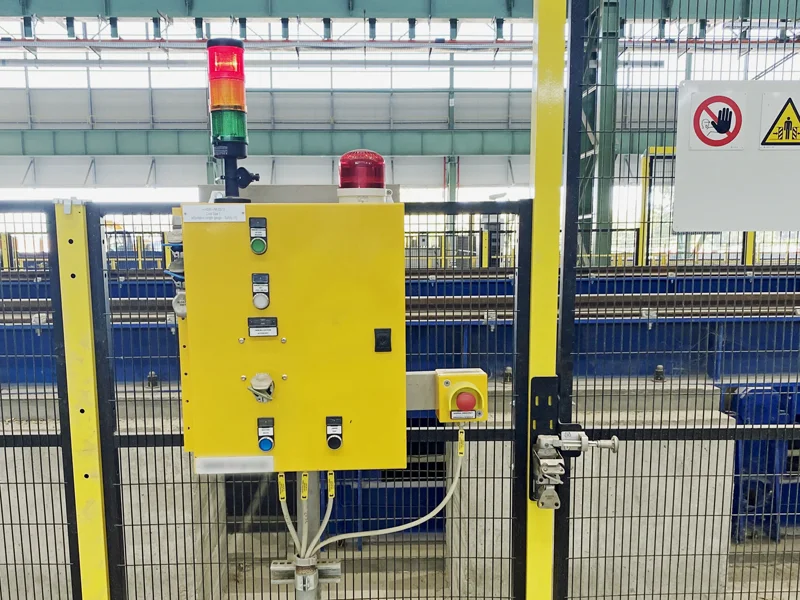
Our Process Steps:
- Comprehensive risk assessment
We identify every task that requires human access to the danger zone, from clearing jams to routine cleaning, to ensure the selected device matches the specific risk profile. - Motivation to defeat analysis
As per ISO 14119:2024, we assess whether the safety measures make these tasks unnecessarily difficult or time-consuming. If such operational hindrance creates an incentive to bypass the interlock, we modify the guarding arrangement or logic to eliminate the incentive. - Fault masking elimination
Connecting multiple standard switches in series can lead to “fault masking,” where the operation of one guard hides a failure in another, dangerously degrading the system’s reliability. We design architectures using OSSD self-testing technology to prevent this, ensuring that high Performance Levels (e.g. PLe) are maintained even across complex, multi-guard installations. - System validation
We validate the final installation and the safety function performance utilising Sistema software in accordance with EN 13849-2 to prove the system’s performance and integrity.
Specialised Industry Solutions
Logistics and warehousing
We specialise in preventing “Whole Body Access” risks in ASRS and conveyor systems. By integrating personnel safety keys, we ensure that a machine cannot be restarted while an operator is inside the danger zone, a mandatory requirement for automated warehousing.
Food and beverage
For manufacturers in this sector, we specify IP69K-rated devices that withstand aggressive chemical cleaning (CIP/SIP) without failing. These devices feature smooth, self-draining surfaces to prevent bacterial growth, ensuring hygiene standards are met alongside safety requirements.
Heavy industry
We design bespoke trapped key logic (Type 5) for heavy industry to enforce strict sequential shutdown procedures. This ensures that multiple energy sources are isolated in a specific order before access is granted, protecting personnel in high-risk environments.
Ready to Enhance Your Safety Systems?
From an initial survey and defeat-motivation assessment to the installation of compliant, productivity-enhancing interlocks, our end-to-end service ensures effective and sustainable machinery safety.