


Electrical Engineering
Electrical Engineering for Machine Safety
In modern manufacturing, warehousing and industrial operations, a machine’s electrical system acts as its central nervous system, dictating every movement, process and safety-critical response function.
Effective electrical engineering for machine safety therefore means the expert design, installation and verification of these systems, including the careful design of safety circuits for specific manufacturing environments and machine guarding applications.
At Safety Systems Technology (SST), our services ensure the safety-critical elements of your machinery are correctly designed, installed and verified against the relevant standards. This gives you the assurance of safety, compliance and dependability backed by our wider Guarding Design, Compliance and PUWER Services, so you have a single, accountable partner across the full machine safety lifecycle.
Compliance is engineered into every project we deliver, from the first circuit diagram to final sign-off.
Compliance with machinery safety legislation is measured against defined, auditable standards, not something left to interpretation. Two complementary standards form the backbone of every electrical engineering project SST undertakes, and both are applied as standard practice on every project we deliver.
- BS EN 60204-1 provides the essential framework for electrical safety, covering the design, construction and verification of electrical equipment on machinery.
- BS EN ISO 13849-1 ensures the control systems that use that electrical equipment are reliable enough to perform their designated safety functions, defining the required Performance Level (PLr) for each safety function.
All our electrical engineering solutions are delivered within the framework of PUWER 1998 and the Supply of Machinery (Safety) Regulations 2008. See our dedicated Compliance and PUWER pages for full detail.
The Importance and Value of Electrical Integrity
Investing in expert electrical engineering strengthens operational and overall business performance. A reliable, well-engineered electrical system enhances productivity by reducing costly downtime and building operator confidence.
Effective electrical engineering:
- Reduces unplanned downtime and costly production stoppages.
- Protects your workforce from electrical and mechanical hazards.
- Extends the operational lifespan of capital equipment.
- Provides audit-ready documentation to support PUWER compliance and insurance requirements.
- Demonstrates due diligence to regulators, insurers and stakeholders.
A Complete Range of Electrical Engineering Services
Safety Systems Technology offers a complete range of services to ensure your machinery’s electrical systems are designed, built, updated and maintained to the highest levels of safety and performance. Some of these services related to specific standards.
- Control system design and integration (to BS EN ISO 13849-1)
We design robust and fault-tolerant safety-related parts of control systems (SRP/CS), engineering the optimal architecture to meet the required Performance Level (PLr) for every safety function. This work sits within the framework of our broader PUWER and Compliance services. - Electrical system design, build and commissioning (to BS EN 60204-1)
SST offers an end to end electrical engineering service for your machinery, including control panel design, on site installation and full commissioning. Every installation can subsequently be verified through our EN60204 Testing service. - Safety circuit design and implementation
Our team has extensive expertise designing and implementing critical circuits, including fail safe emergency stop systems, interlocking devices, two hand controls and safety light curtains. - Electrical system upgrades and modernisation
We conduct comprehensive audits of legacy machinery to identify compliance gaps and performance bottlenecks, upgrading outdated systems to meet current standards and improve reliability. - Re-engineering of imported machinery
Importers of machinery from outside Great Britain are legally responsible for its compliance. We offer complete electrical redesign and rebuild services to guarantee equipment meets SMSR and PUWER. See our CE and UKCA marking service for how we support your conformity documentation.
Northern Ireland. Northern Ireland follows EU rules, not Great Britain’s. Machinery must carry CE marking (not UKCA) under the EU Machinery Directive 2006/42/EC, and work equipment falls under the Provision and Use of Work Equipment Regulations (Northern Ireland) 1999, the NI equivalent of PUWER.
- Compliance audits, verification and testing: Our engineers provide independent testing and auditing to verify conformance to all relevant standards, drawing on our EN60204 Testing and Stop Time Testing services where applicable.
- Technical documentation and UKCA/CE marking support: We assist clients in compiling complete and compliant technical files, including wiring diagrams, risk assessments and test results. Full detail is available on our CE and UKCA Marking page.
Book a Review
Leave your details below and we’ll get back to you as soon as possible.
Our Proven Five-Step Methodology
At Safety Systems Technology, we employ a structured process that provides transparency and minimises disruption, with a predictable and high-quality outcome, ensuring machine safety compliance with PUWER and optimising operating efficiency. The five steps are:
- Assessment and risk analysis: We start with a thorough on-site assessment and risk analysis of your existing machinery and their electrical systems to identify any compliance gaps and potential failure points.
- Prioritisation and collaborative design: Based on this assessment, we work with your team to prioritise modifications and engineer a solution that is compliant, efficient, and aligned with your operational goals and how machinery is used.
- System integration and installation: Our team manages the complete installation process, from control panel building to on-site wiring, meticulously planning all work to minimise disruption to your production schedule.
- Rigorous testing and validation: Following installation, we conduct comprehensive functional and electrical tests to verify that the system performs exactly as specified and meets the stringent requirements of all relevant standards.
- Comprehensive documentation and handover: We deliver a complete and compliant technical file containing all schematics, risk assessments, calculations and certified test results, providing an essential record for future maintenance and audits.
Core Safety Standards – Technical Detail
Together, these standards address the two questions that matter most when a machine is inspected, audited or investigated: firstly is the electrical system built and installed correctly, and secondly, will the safety functions perform reliably when called upon?
Every electrical engineering project delivered by SST is designed, installed and verified against these standards, with full documentation to support your PUWER compliance file.
BS EN 60204-1: Fundamental Electrical Safety
This is the principal standard governing the electrical safety of machinery in the UK and throughout the EU. It applies to the entire electrical system of a machine from the point of supply, with the goal of promoting safety, ensuring consistent control responses and facilitating ease of maintenance.
| Standard Clause | Key Requirement | What This Means for Your Machinery |
|---|---|---|
| Clause 5 | Incoming Supply and Disconnecting Devices | Your machine must have a single, clearly identifiable and lockable main isolator. |
| Clause 6 | Protection Against Electric Shock | All live parts must be enclosed. A reliable protective bonding circuit must be in place. |
| Clause 9 | Control Circuits and Control Functions | Emergency Stop circuits must be hard-wired, fail-safe and override all other functions. |
| Clause 10 | Operator Interface and Control Devices | Buttons must follow a strict colour code for safe operation. |
| Clause 17 | Technical Documentation | A comprehensive set of electrical drawings and test certificates must be available. |
BS EN ISO 13849-1: Ensuring Functional Safety
At Safety Systems Technology, we have extensive experience of supplying machine guarding to facilities in very diverse range of industries. We’ve installed guarding for and continue to provide industry safety solutions to business from heavy industry to food tech, from polymer processing to pharmaceuticals, from logistics warehouses to scientific research laboratories. No machinery, environment internal or external phases us!
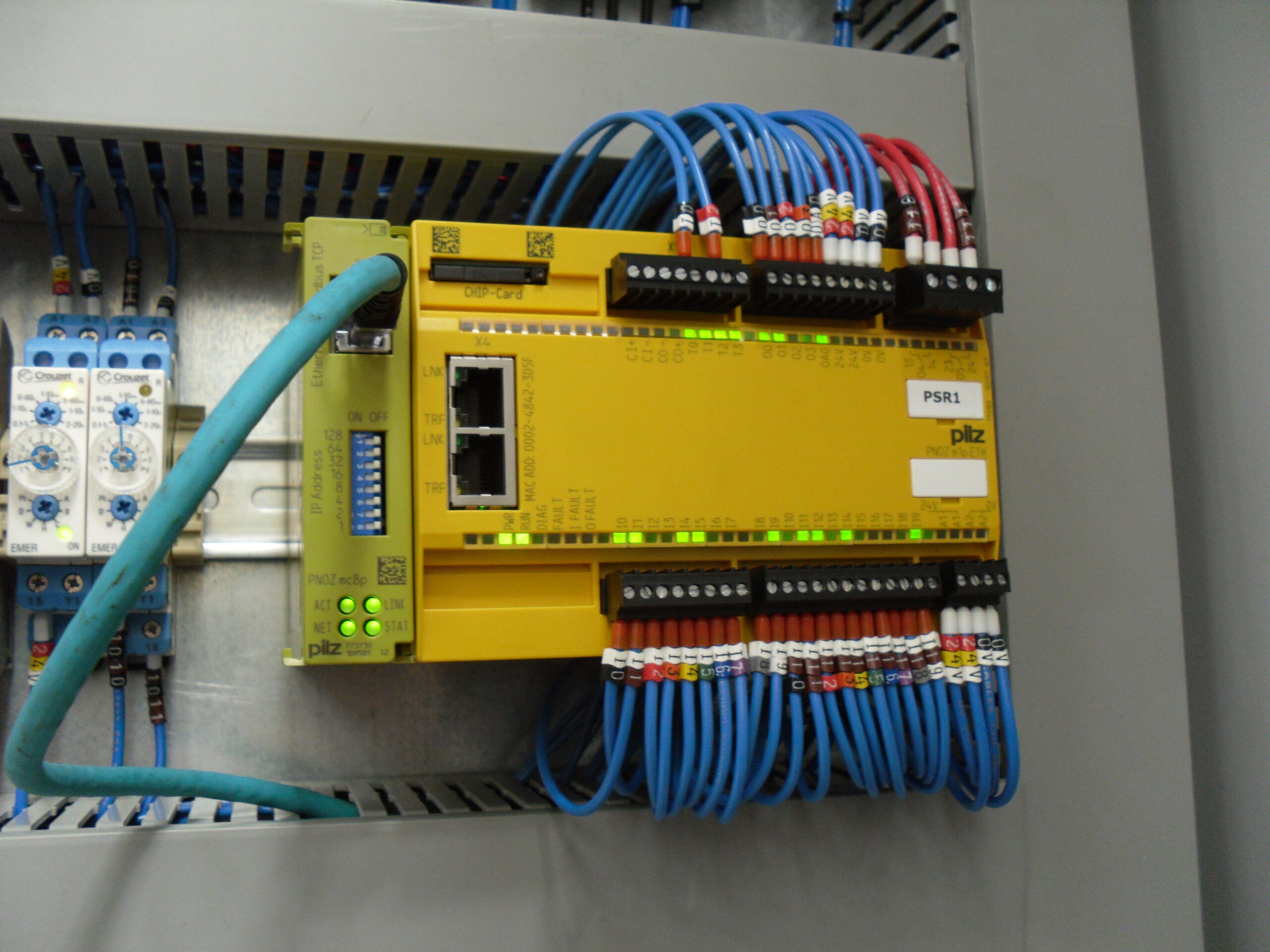
BS EN ISO 13849-1 focuses on functional safety. This is the part of a machine’s overall safety that depends on the correct functioning of its control systems. Rather than being a separate system, as is the case with older or legacy machines, modern machinery electrical safety is designed into the main control system. Often referred to as Safety-Related Parts of a Control System (SRP/CS), the functional safety system consists of:
Safety inputs
Safety inputs that detect hazards (e.g. safety light curtains, emergency stop buttons).
Safety logic
Safety logic that processes the signals (e.g. a safety programmable logic controller (PLC) or safety relays).
Safety outputs
Safety outputs that execute the safety command (e.g. contactors that de-energise a motor).
The goal of functional safety is to ensure that if a failure occurs, the machine will “fail-safe” – reverting to a safe state rather than a potentially dangerous one.
The purpose of the BS EN ISO 13849-1 standard is to answer the question: “How reliable is the control system that performs a safety function?” The core concept is based on a Performance Level (PL), a rating from ‘a’ (lowest reliability) to ‘e’ (highest reliability).
The required Performance Level (PLr) is determined through a structured risk assessment that considers three key factors:
S (Severity of Injury)
From S1 (slight and reversible) to S2 (serious or fatal).
F (Frequency of exposure)
From F1 (seldom) to F2 (frequent or continuous).
P (Possibility of avoiding hazard)
From P1 (possible) to P2 (scarcely possible).
The combination of these factors determines the PLr that the safety control system must be designed to achieve. For example, a hazard that could cause a serious injury (S2), to which an operator is frequently exposed (F2), and which is scarcely possible to avoid (P2), would demand the highest required Performance Level, PLr = e. The safety circuit design must then achieve this target.
| Performance Level (PL) | Required System Reliability | Average Probability of Dangerous Failure per Hour (PFHD) | Typical Application Example |
|---|---|---|---|
| a | Low | ≥10-5 to <10-4 | A non-critical monitoring function where failure has minor consequences. |
| b | Low to Medium | ≥3×10⁻⁶ to <10-5 | A simple safety function where the risk of injury is very low. |
| c | Medium | ≥10-6 to <3×10⁻⁶ | A standard interlocking guard on a machine with a low frequency of access and low-speed hazards. |
| d | High | ≥10-7 to <10-6 | A safety light curtain on a production line where access is frequent and failure could lead to serious, irreversible injury. |
| e | Very High | ≥10-8 to <10-7 | A critical safety function on a high-speed robot or press where failure is likely to be catastrophic. |
Experience Across Sectors
Safety Systems Technology has extensive experience delivering electrical engineering and safety circuit solutions across a diverse range of regulated industries, including:
- Defence and Aerospace
- Food and Beverage
- Recycling
- Steel Making
- Engineering Workshops
- Medical and Pharmaceutical
- Packaging Production
No machinery or environment, internal or external, phases us.
Compliance
All our electrical engineering solutions are delivered within the framework of PUWER 1998 and the Supply of Machinery (Safety) Regulations 2008. Read more on our dedicated Compliance and PUWER pages.
Partner with SST for
Robust, Compliant and Productive Electrical Engineering for Your Machinery
Contact our expert engineering team today for a no-obligation consultation to discuss your electrical safety and compliance needs.
Is Your Electrical System
Fully Compliant?
From initial assessment and control system design through to installation, on-site commissioning and full compliance verification, our end-to-end electrical engineering service ensures your machinery’s safety-critical systems are correctly designed, reliably installed and fully auditable.
Get in touch with us today to ask for a no obligation consultation
Read Our Case Studies
Don’t just take our word for it. See how we have helped others safeguard their staff with our machine guarding design and implementation.
Company Overview
Safety Systems Technology specialises in delivering tailored safety systems and machine guarding solutions that meet PUWER, BS, EN and ISO standards. With expert knowledge and innovative designs, we help businesses create safer, compliant and efficient operations.