
Address: Unit 3, Westbury Street, Elland, HX5 9AT
CE and UKCA marking for machinery is a legal declaration under the Supply of Machinery (Safety) Regulations 2008 (SMSR) that machinery complies with the Essential Health and Safety Requirements (EHSRs) and may be lawfully placed on the market or put into service.
Since October 2024, CE marking has been recognised indefinitely in Great Britain under The Product Safety and Metrology (Amendment) Regulations 2024. For machinery placed on the market in England, Scotland and Wales, CE marking fulfils the legal requirement where self certification applies.
In Northern Ireland, CE marking remains mandatory. Where mandatory third party assessment is carried out by a UK Approved Body for machinery placed on the Northern Ireland market, both CE and UKNI marking are required.
However, responsibility for marking does not always remain with the original equipment manufacturer. In many industrial environments, that responsibility transfers to the integrator, importer, or employer placing machinery into service.
When responsibility for marking transfers from the original manufacturer to your organisation, we provide the structured engineering assessment required to support lawful CE, UKCA, or UKNI marking – ensuring compliance is demonstrable through documented assessment and capable of withstanding regulatory scrutiny.
The Supply of Machinery (Safety) Regulations 2008 implement in Great Britain the requirements of the EU Machinery Directive 2006/42/EC and require machinery placed on the market to meet the Essential Health and Safety Requirements set out in Schedule 2 of the Regulations. In Northern Ireland, the Machinery Directive continues to apply directly.
The Supply of Machinery (Safety) Regulations 2008 implement the requirements of the EU Machinery Directive 2006/42/EC into domestic law in Great Britain. In Northern Ireland, the Directive continues to apply directly.
Under the Regulations, the “Responsible Person”, the legal entity (usually the manufacturer, but sometimes the integrator, importer, or employer placing the machinery on the market or putting it into service) must ensure those requirements are satisfied before marking is applied.
The EHSRs establish a defined hierarchy of risk reduction. Hazards must be eliminated by design where possible. Where elimination is not achievable, suitable safeguarding must be provided. Safety‑related control systems must achieve appropriate reliability and fault tolerance, electrical systems must comply with applicable safety requirements.
Additionally, operators must be provided with adequate instructions, and machinery must incorporate appropriate warnings and safety markings. Separate duties relating to training arise under PUWER once the equipment is in use.
Before a CE or UKCA mark is affixed, the Responsible Person must be able to demonstrate, through documented risk assessment, validation, and supporting technical evidence, that all applicable requirements have been met.
The mark is a legal declaration. It must be supported by evidence.
A business commonly becomes the Responsible Person in two situations.
When separately CE marked machines are integrated into a functionally linked system operating as a single production line, the resulting assembly constitutes new machinery under the Regulations.
Although individual machines may have been previously compliant in isolation, the integrated system must be assessed as a whole. This includes hazards created at interfaces, emergency stop functionality across the line, control system integration, new guarding arrangements and overall functional safety performance.
The integrator, often the employer operating the site, assumes responsibility for conformity assessment, technical file compilation, issuance of the Declaration of Conformity, and affixing the CE or UKCA marking to the assembly.
Where machinery is imported directly into the UK and has not previously been placed on the UK or EEA market, the importer (again, often the employer) assumes responsibility for compliance.
Imported machinery often requires verification of guarding, safety distances, control system performance, electrical design and documentation. Where deficiencies are identified, corrective measures must be implemented before a Declaration of Conformity is issued and marking applied.
Routine maintenance does not constitute substantial modification and does not trigger re marking.
In Great Britain (England, Scotland and Wales), CE marking has been recognised indefinitely since October 2024 under The Product Safety and Metrology (Amendment) Regulations 2024. Where mandatory third‑party conformity assessment is not required, manufacturers may apply CE marking under internal production control (self‑certification).
Certain higher‑risk categories of machinery are listed in Schedule 2 Part 4 of the Regulations (retained from Annex IV of the Machinery Directive). These include equipment such as woodworking machinery, metal forming presses, vehicle lifts, lifting appliances for persons, and certain protective devices. These categories trigger additional conformity assessment routes where harmonised or designated standards are not fully applied.
Where required, third‑party conformity assessment must be carried out by an appropriately designated UK Approved Body or EU Notified Body (for example, BSI, TÜV SÜD, SGS or Bureau Veritas), depending on the applicable marking regime. Where a UK Approved Body is used for mandatory assessment for machinery placed on the market/or put to use in Great Britain, UKCA marking is required.
In Northern Ireland, CE marking remains mandatory. Where mandatory third‑party assessment is carried out by a UK Approved Body for machinery placed on the Northern Ireland market, both CE and UKNI marking are required.
Valid conformity marking consists of three elements:
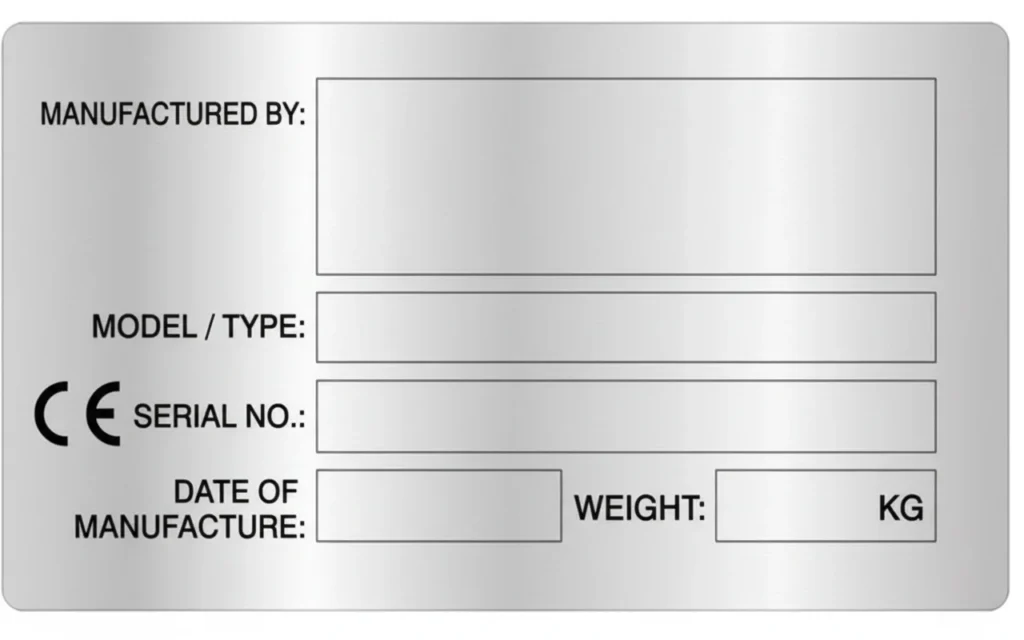
The marking plate forms part of the statutory marking required under Schedule 2 of the Regulations. Incorrect, incomplete or non durable marking plates may invalidate the conformity marking, even where the technical file is otherwise adequate.
In enforcement proceedings, the technical file determines the validity of the marking.
The Regulations define safety objectives but do not prescribe engineering methods. Compliance is normally demonstrated through application of designated (UK) or harmonised (EU) standards, which provide a presumption of conformity with the Essential Health and Safety Requirements. This provides the recognised technical basis for CE and UKCA marking for machinery in the UK. Assessment of assemblies and imported machinery commonly references:
Where standards are not applied in full, equivalent engineering justification must be documented.
When an organisation becomes responsible for CE or UKCA marking, a structured machinery conformity assessment is required.
Safety Systems Technology Ltd carries out technical assessment of integrated machinery assemblies, imported equipment, and substantially modified installations to determine whether the Essential Health and Safety Requirements have been satisfied.
This work includes formal risk assessment, evaluation of safety‑related control systems against BS EN ISO 13849‑1, verification of electrical compliance to EN 60204‑1 and assessment of guarding and safety distances against applicable standards.
Where non‑compliances are identified, corrective measures are specified. Assistance with technical file preparation, Declaration of Conformity drafting and verification of machine plaque compliance is provided where required. This includes confirmation that statutory marking particulars are correctly presented, permanently affixed and formatted in accordance with regulatory requirements.
Services include:
Unsupported or incorrect marking may result in Improvement or Prohibition Notices, withdrawal from service, financial penalties, and potential criminal liability. Enforcement action frequently arises from incomplete or incorrectly specified marking plates, particularly where manufacturer details, year of construction or conformity marks are missing or incorrectly formatted.
Verification prior to placing machinery on the market or into service reduces regulatory and operational risk.
If machinery is being integrated, imported, or substantially modified, assessment should be carried out before marking is applied.
Conformity marking is a legal declaration. It must be justified.
Don’t just take our word for it. See how we have helped others safeguard their staff with our machine guarding design and implementation.
Whether you are integrating production lines, importing equipment or undertaking substantial modification, we provide structured conformity assessment to support lawful and compliant marking under the Supply of Machinery (Safety) Regulations 2008.
Contact us to discuss your project or request an initial technical review.