When Is Fixed Guarding Mandatory Under PUWER?
If you’re responsible for workforce safety, you’ll already recognise just how important the selection of safeguarding method is. In scenarios where interlocks are an effective solution, it’s vital for both safety and compliance to know which more appropriate – interlocked or fixed guarding. This is particularly the case in heavy engineering or fulfilment operations where increasing automation, developing technology and changing regulation are blurring the boundaries between mechanical isolation and electronic control, so making the identification of an effective safeguarding strategy increasingly complex.
In simple terms, whilst fixed guards provides absolute physical isolation, interlocked guard facilitates the necessary interface between human operators and automated processes.
Key Takeaways
- Fixed guards are the legal priority. Under PUWER Regulation 11, fixed guards must be used if they can be fitted without making the machine inoperable, regardless of the cost.
- Interlocks facilitate necessary access. These devices are required when routine tasks – such as clearing jams or performing washdowns – make static barriers operationally impossible.
- Guard locking is significant for high-inertia machines. If a machine takes time to stop after power is removed, a physical lock must prevent access until all motion has ceased.
- Tamper resistance reduces risk. Modern RFID-coded switches are superior to traditional mechanical interlocks because they cannot be easily bypassed with spare parts or magnets.
- Technical reliability is measured by performance levels. Most serious industrial applications require a PL e system with Category 4 architecture to ensure fault tolerance.
Fixed guarding: the default solution where practicable
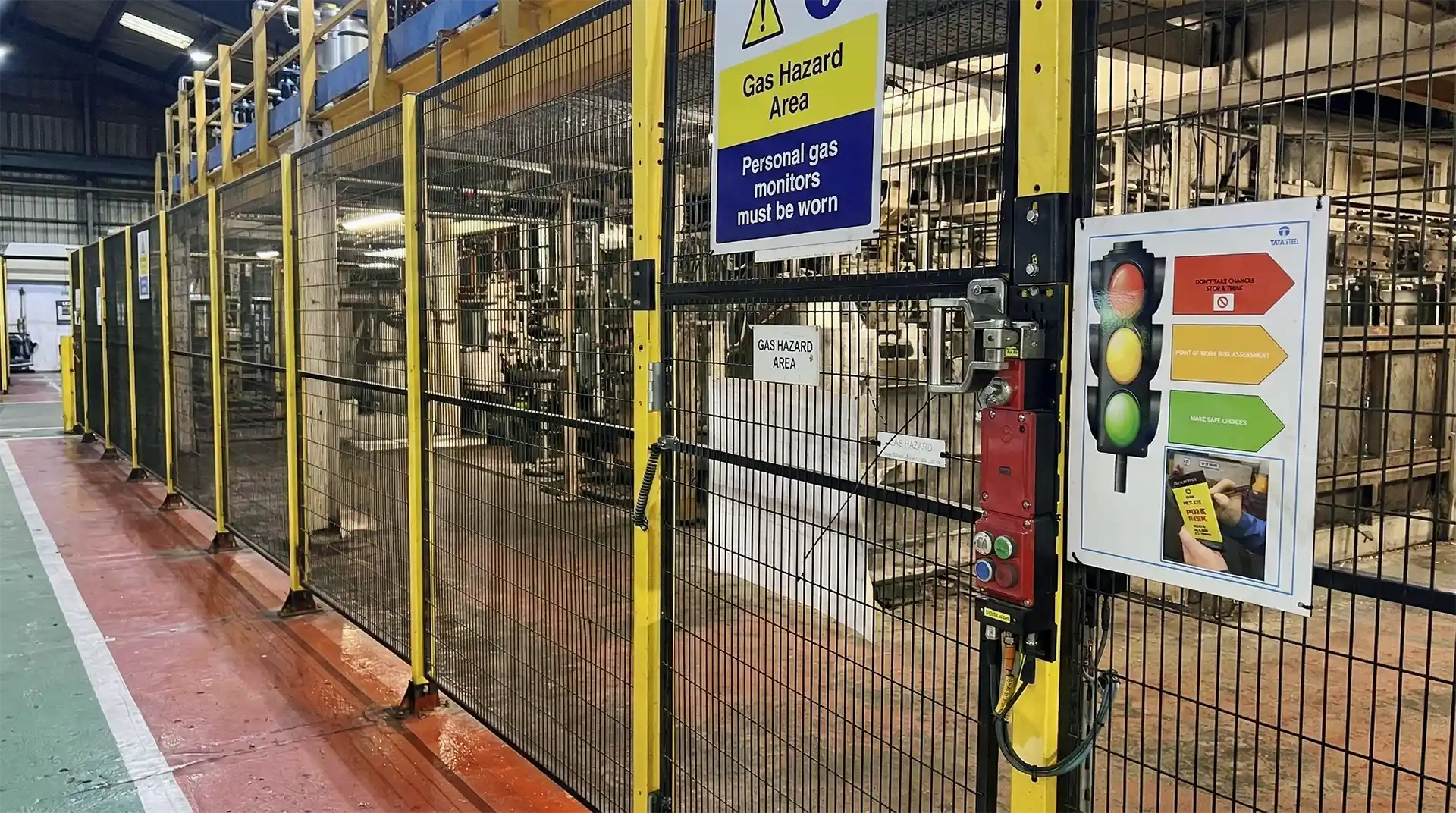
Fixed guards are physical barriers with no moving parts, designed to totally enclose a hazard and are the preferred method of protection for high-volume automation where operator intervention is not required during normal production. Under Regulation 11 of the Provision and Use of Work Equipment Regulations 1998 (PUWER), a clear hierarchy of guarding stipulates fixed guards should be used wherever it is ‘practicable’. See the blog article “What is the Danger Zone in Machine Guarding” for a clear explanation of this.
In a legal context, ‘practicable’ implies that if a fixed guard can be physically fitted without rendering the machine inoperable, it must be installed regardless of the financial cost. These guards must be of robust construction and securely held in place according to the BS EN ISO 14120 standard. It’s important to recognise the fundamental point that there is a requirement that these barriers must only be removable with the use of tools. Furthermore, standards also dictate that fasteners, such as screws or nuts, must remain attached to the guard or the machinery when removed to prevent their loss.
The engineering of these guards must account for physical impact to ensure the barrier remains effective if struck by moving machinery or ejected workpieces. While ISO 14120 dictates that a standard safety guard should withstand an impact of at least 115J, this is typically a baseline for light manufacturing. In heavy-engineering or fulfilment environments, these requirements are frequently scaled up to 329J or 767J to account for the kinetic energy of larger machinery or high-speed automated systems. This introduces an additional technical requirement to the process of selection, with a detailed assessment needed to ensure the mechanical resistance of the installation is matched to the specific foreseeable hazards of the site.
Interlocking devices: managing operational access
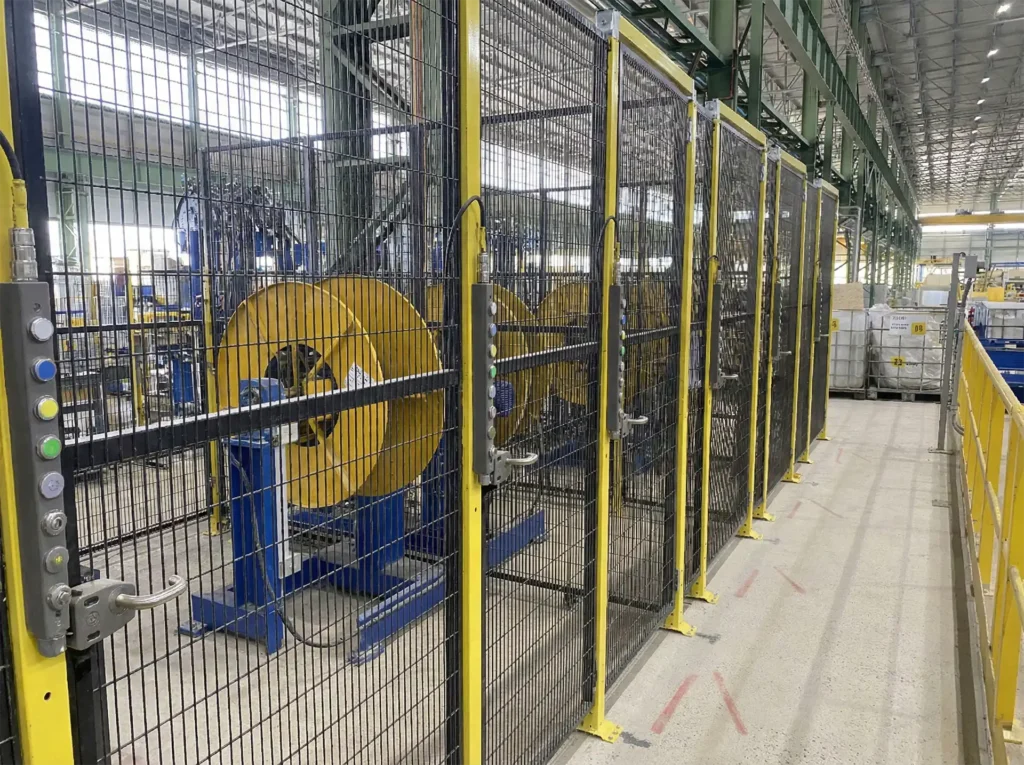
Because interlocks allow barriers to be opened, they are suited to systems where routine access is required, such as clearing jams or performing washdowns. Interlocked guards are connected to the machine-control system via a device that disengages power when opened. The selection of interlocking devices, to use the official terminology defined by BS EN ISO 14119, is dictated by two primary types of logic:
Interlocking without guard locking:
This allows the guard to be opened at any time. As soon as the guard is moved, the interlocking device sends a stop signal to the machine. This is only appropriate for machinery with a very short run-down time, where the hazard ceases before a person can reach the danger zone.
Interlocking with guard locking:
This uses a physical bolt or solenoid to keep the guard locked until a safe state is reached. This is critical requirement for high-inertia machinery that takes time to stop after power is removed. Preventing premature access reduces the motivation to defeat the system, as operators cannot attempt to enter the area while the machine is still in motion.
Overcoming motivation to defeat the system
An important part of the design process involves assessing potential operator motivation to defeat the device. If a safety sequence is too slow or obstructive, it increases the risk of users attempting to bypass the system.
Whilst traditional mechanical-tongue interlocks are often easily defeated with spare keys, modern alternatives offer varying levels of tamper resistance, with RFID (radio-frequency identification)-coded switches providing high tamper resistance. This is because the sensor only accepts a uniquely matched actuator code, preventing the use of magnets or spare parts to bypass the safety system.
Complying with UK and Irish guarding regulations
In both the UK and Ireland, the choice between fixed and interlocked guarding is a central component of workplace safety law. Under PUWER, and the equivalent General Application Regulations in Ireland, employers have a legal duty to ensure that machinery is fitted with the most effective form of protection for the specific task at hand.
The choice between fixed guards and interlocking devices involves balancing the need for absolute physical isolation with operational requirements. Whether using a static barrier or a RFID-coded system, the goal is to provide a solution that is robust enough to protect the workforce while minimising the motivation to defeat the safety measures.
Designing for the human element
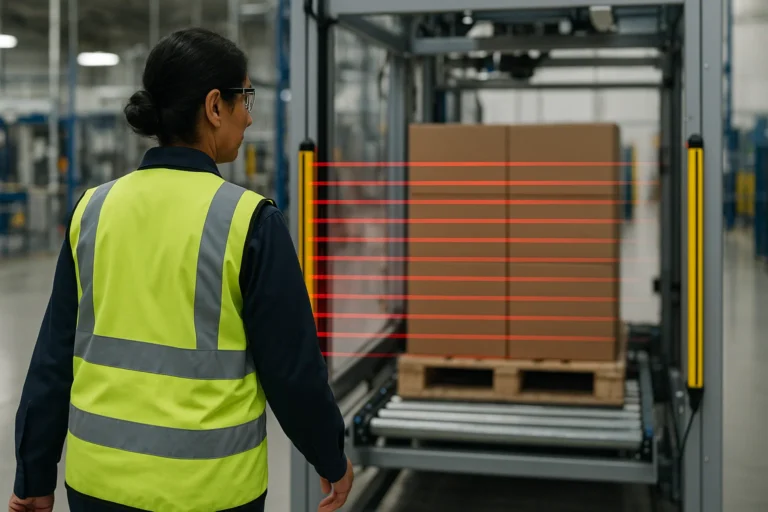
There are scenarios where ‘whole-body access’ risks have to be mitigated. For example, robotic manufacturing cells or when machines from different vendors are integrated together, forming ‘complex assemblies’, such as high-speed automated-storage and retrieval-systems (ASRS)
Under the Supply of Machinery (Safety) Regulations 2008 (SMSR) and PUWER, specific measures are required to prevent the machinery from being re-energised while a person is inside and potentially be hidden from view.
Solutions can include:
- Trapped-key interlocking: this is a mechanical sequence where the operator takes a personal safety-key into the zone to prevent a restart.
- Escape release: safety-gates must be openable from the inside without the use of tools.
The reliability of these safety functions is assessed via a ‘Performance Level’ (PL). For most industrial machinery where serious injury is possible and exposure is frequent, a PL e system is required. While PL e ensures high technical reliability through redundancy and diagnostic coverage, it does not inherently reduce the motivation to bypass a system. Mitigating that risk requires a combination of ergonomic design and tamper-resistant technology, to ensure safety measures do not unnecessarily impede workflow. When using interlocks without locking, the safety distance (S) must be calculated to ensure the machine stops before a hazard is reached:
Achieving PL e usually requires a Category 4 architecture. This is a technical requirement of the standard that mandates ‘fault-tolerance’ through dual-channel redundancy and continuous self-monitoring.
S = (K × T) + C
Where S is the safety-distance, K is the approach-speed, T is the total system stopping-time and C is the intrusion-distance.
Summary of guarding selection
| Feature | Fixed guards | Interlocking guards |
|---|---|---|
| Primary use | Constant isolation where operator access is infrequent. | Frequent access for tasks such as clearing jams or maintenance. |
| Access control | Requires the use of tools for removal or adjustment. | Integrated with the machine control system via a sensing device. |
| Maintenance | Weekly visual check for missing fasteners or structural damage. | Functional verification that opening a gate stops all motion. |
| Tamper resistance | High via the use of captive fasteners. | Variable – RFID coded switches provide the highest resistance. |
| Performance Level (PL) | Generally not applicable as these are passive physical barriers. | Often requires PL e where serious injury or frequent exposure is possible. |
| Safety architecture | Robust physical construction meeting BS EN ISO 14120. | Typically demands Category 4 architecture with high diagnostic coverage and redundancy. |
Ultimately, selecting between fixed and interlocking guards is a balance of operational logic and safety. Fixed guards remain the baseline for isolation where access is infrequent, while interlocking systems are significant for maintaining throughput in dynamic environments.
Frequently Asked Questions
When is a fixed guard considered 'practicable'?
In a legal and engineering context, a fixed guard is practicable if it is physically possible to install it without preventing the machine from performing its intended function. If it can be fitted, PUWER dictates that it must be used as the primary method of protection.
Does a UKCA or CE mark guarantee our guards are compliant?
Not necessarily. While these marks confirm the machine met safety regulations when it left the manufacturer, PUWER is an ongoing duty for the employer. You must ensure the guarding remains effective as it is installed, used, and maintained in your specific facility.
Why should we use RFID-coded interlocks instead of standard tongue switches?
Mechanical tongue interlocks are often easily defeated with spare keys, which increases the risk of operators bypassing safety measures to save time. RFID-coded switches require a uniquely matched actuator code, providing a much higher level of tamper resistance.
What is a 'complex assembly' in a warehouse environment?
A complex assembly occurs when machines from different vendors are integrated into a single system, such as a conveyor feeding an automated wrapper. In these cases, the site operator often becomes the ‘manufacturer’ in the eyes of the law and must ensure all interfaces are safe.